Geometric 3-manifolds
|
This page has not been refereed. The information given here might be incomplete or provisional. |
Contents |
[edit] 1 Introduction
Let a group  act on a manifold
  by homeomorphisms.
A  -manifold is a manifold
  with a -atlas, that is, a collection
  of homeomorphisms

onto open subsets of such that all coordinate changes

are restrictions of elements of .
 and a chart
  with
with  . Let
. Let  be the universal covering. These data determine the developing map
 along each path, in a neighborhood of the path's endpoint.
If we change the initial data  and , the developing map
  changes by composition with an element of .
 , analytic continuation along a loop representing
  gives a chart
  that is comparable to
  , since they are both defined at . Let
  be the element of such that
  . The map
is a group homomorphism and is called the holonomy of .
If we change the initial data and , the holonomy homomorphisms  changes by conjugation with an element of .
A -manifold is complete if the developing map  is surjective.
[Thurston1997] Section 3.4
Definition 1.1.
A model geometry is a smooth manifold together with a Lie group of diffeomorphisms of , such that:
a) is connected and simply connected;
b) acts transitively on , with compact point stabilizers;
c) is not contained in any larger group of diffeomorphisms of with compact point stabilizers;
d) there exists at least one compact -manifold.
[Thurston1997] Definition 3.8.1
A 3-manifold is said to be a geometric manifold if it is a -manifold for a 3-dimensional model geometry .
[edit] 2 Construction and examples
Theorem 2.1.There are eight 3-dimensional model geometries:
- the round sphere: 
- Euclidean space: 
- hyperbolic space: 
- 
- 
- the universal covering of the unit tangent bundle of the hyperbolic plane: 
- the Heisenberg group: 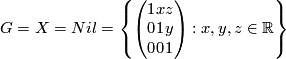
 with conjugation
  .
.[Thurston1997] Section 3.8
Outline of Proof:
Let  be the connected component of the identity of , and let
  be the stabiliser of
  .
acts transitively and is a closed, connected subgroup of
.
acts transitively and is a closed, connected subgroup of  .
.
Case 1:  . Then has constant sectional curvature. The Cartan Theorem implies that (up to rescaling) is isometric to one of
  .
.
Case 2:  . Let
. Let  be the -invariant vector field such that, for each , the direction of
  is the rotation axis of . descends to a vector field on compact -manifolds, therefore the flow of must preserve volume. In our setting this implies that the flow of acts by isometries. Hence the flowlines define a 1-dimensional foliation
  with embedded leaves. The quotient
  is a 2-dimensional manifold, which inherits a Riemannian metric such that acts transitively by isometries. Thus
  has constant curvature and is (up to rescaling) isometric to one of
  . is a pricipal bundle over
  with fiber
  or
or  ,
The plane field
,
The plane field  orthogonal to
  has constant curvature, hence it is either a foliation or a contact structure.
Case 2a: is a foliation. Thus is a flat bundle over . is one of , hence  , which implies that
  .
.
Case 2b: is a contact structure.
For  one would obtain for the group of isometries of
  that preserve the Hopf fibration. This is not a maximal group with compact stabilizers, thus there is no model geometry in this case.
For
that preserve the Hopf fibration. This is not a maximal group with compact stabilizers, thus there is no model geometry in this case.
For  one obtains
  . Namely, is the subgroup of the group of automorphisms of the standard contact structure
  on
on  consisting of those automorphisms which are lifts of isometries of the x-y-plane.
For
consisting of those automorphisms which are lifts of isometries of the x-y-plane.
For  one obtains .
Case 3:  . Then
  is a Lie group. The only 3-dimensional unimodular Lie group which is not subsumed by one of the previous geometries is
  .
.
[edit] 3 Invariants
...
[edit] 4 Classification/Characterization
A closed 3-manifold is called:
- irreducible, if every embedded 2-sphere bounds an embedded 3-ball,
- geometrically atoroidal, if there is no embedded incompressible torus,
- homotopically atoroidal, if there is no immersed incompressible torus.
Theorem 4.1 (Geometrization).
Let be a closed, orientable, irreducible, geometrically atoroidal 3-manifold.
a) If is homotopically atoroidal, then it admits an  -geometry.
b) If is not homotopically atoroidal, then it admits (at least) one of the seven non--geometries.
Example 4.2 (Geometrization of mapping tori).
Let  be an orientation-preserving homeomorphism of the surface of genus
  .
.
a) If  , then the mapping torus
  satisfies the following:
1. If  is periodic, then admits an geometry.
2. If is reducible, then contains an embedded incompressible torus.
3. If is Anosov, then admits a  geometry.
b) If  , then the mapping torus satisfies the following:
1. If is periodic, then admits an  -geometry.
2. If is reducible, then contains an embedded incompressible torus.
3. If is pseudo-Anosov, then admits an -geometry.
As the example suggests, the most abundant case ist that of Hyperbolic 3-manifolds.
[edit] 5 Further discussion
...
[edit] 6 References
- [Thurston1997] W. P. Thurston, Three-dimensional geometry and topology. Vol. 1, Princeton University Press, Princeton, NJ, 1997. MR1435975 (97m:57016) Zbl 0873.57001

