Aspherical manifolds
|
An earlier version of this page was published in the Bulletin of the Manifold Atlas: screen, print. You may view the version used for publication as of 12:23, 27 September 2012 and the changes since publication. |
|
The user responsible for this page is Lueck. No other user may edit this page at present. |
1 Introduction
This page is devoted to aspherical closed manifolds.
Definition 1.1.
A space  is called aspherical if it is path connected and all its higher homotopy groups vanish, i.e.,
  is trivial for
  .
.
Aspherical closed manifolds are very interesting objects since there are many examples, intriguing questions and conjectures about them. For instance:
- Interesting geometric constructions or examples lead to aspherical closed manifolds, e.g., non-positively curved closed manifolds, closed surfaces except
 and
and  , irreducible closed orientable
  -manifolds with infinite fundamental groups, locally symmetric spaces arising from almost connected Lie groups and discrete torsionfree cocompact lattices.
- There are exotic aspherical closed manifolds which do not come from standard constructions and have unexpected properties, e.g., the universal covering is not homeomorphic to
 , they are not triangulable. The key construction methods are the reflection trick and hyperbolization.
- Which groups occur as fundamental groups of aspherical closed manifolds?
- The Borel Conjecture predicts that aspherical closed topological manifolds are topologically rigid, i.e., any homotopy equivalence of aspherical closed manifolds is homotopic to the identity.
- The condition aspherical is of purely homotopy theoretical nature. Nevertheless there are some interesting questions and conjectures such as the Singer Conjecture and the Zero-in-the-Spectrum Conjecture about the spectrum of the Laplace operator on the universal coverings of aspherical closed Riemannian manifolds.
2 Homotopy classification of spaces
From the homotopy theory point of view an aspherical  -complex is completely determined by its fundamental group. Namely,
Theorem 2.1 [Homotopy classification of aspherical spaces].
Two aspherical -complexes are homotopy equivalent if and only if their fundamental groups are isomorphic.
Proof.
By Whitehead's Theorem (see [Whitehead1978, Theorem IV.7.15 on page 182]) a map between -complexes is a homotopy equivalence if and only if it induces on all homotopy groups bijections. Hence it suffices to construct for two aspherical -complexes and  together with an isomorphism
  a map
a map  which induces
  on the fundamental groups. Any connected -complex is homotopy equivalent to a -complex with precisely one
  -cell, otherwise collapse a maximal sub-tree of the
  -skeleton to a point. Hence we can assume without loss of generality that the -skeleton of is a bouquet of -dimensional spheres. The map tells us how to define
  , where
  will denote the
  -skeleton of . The composites of the attaching maps for the two-cells of with
  are null-homotopic by the Seifert-van Kampen Theorem. Hence we can extend to a map
  . Since all higher homotopy groups of are trivial, we can extend
  to a map .

Lemma 2.2. A -complex is aspherical if and only if it is connected and its universal covering  is contractible.
Proof. The projection  induces isomorphisms on the homotopy groups
  for and a connected -complex is contractible if and only if all its homotopy groups are trivial (see [Whitehead1978, Theorem IV.7.15 on page 182]).
An aspherical -complex with fundamental group  is the same as an Eilenberg Mac-Lane space
  of type
  and the same as the classifying space
  for the group .
3 Examples of aspherical manifolds
3.1 Non-positive curvature
Let  be a closed smooth manifold. Suppose that it possesses a Riemannian metric whose sectional curvature is non-positive, i.e., is
  everywhere. Then the universal covering
  inherits a complete Riemannian metric whose sectional curvature is non-positive. Since is simply-connected and has non-positive sectional curvature, the Hadamard-Cartan Theorem (see [Gallot&Hulin&Lafontaine1987, 3.87 on page 134]) implies that is diffeomorphic to and hence contractible. We conclude that and hence is aspherical.
3.2 Low-dimensions
A connected closed -dimensional manifold is homeomorphic to  and hence aspherical.
Let be a connected closed  -dimensional manifold. Then is either aspherical or homeomorphic to or
  . The following statements are equivalent:
- is aspherical.
- admits a Riemannian metric which is flat, i.e., with sectional curvature constant , or which is hyperbolic, i.e., with sectional curvature constant
 .
.
- The universal covering of is homeomorphic to
 .
.
A connected closed -manifold is called prime if for any decomposition as a connected sum  one of the summands
  or
or  is homeomorphic to
  . It is called irreducible if any embedded sphere bounds a disk
  . Every irreducible closed -manifold is prime. A prime closed -manifold is either irreducible or an -bundle over (see [Hempel1976, Lemma 3.13 on page 28]). A closed orientable -manifold is aspherical if and only if it is irreducible and has infinite fundamental group. This follows from the Sphere Theorem [Hempel1976, Theorem 4.3 on page 40]. Thurston's Geometrization Conjecture implies that a closed -manifold is aspherical if and only if its universal covering is homeomorphic to
  . This follows from [Hempel1976, Theorem 13.4 on page 142] and the fact that the -dimensional geometries which have compact quotients and whose underlying topological spaces are contractible have as underlying smooth manifold (see [Scott1983]). A proof of Thurston's Geometrization Conjecture is given in [Morgan&Tian2008] following ideas of Perelman. There are examples of closed orientable -manifolds that are aspherical but do not support a Riemannian metric with non-positive sectional curvature (see [Leeb1995]). For more information about -manifolds we refer for instance to [Hempel1976, Scott1983].
3.3 Torsionfree discrete subgroups of almost connected Lie groups
Let  be a Lie group with finitely many path components. Let
  be a maximal compact subgroup. Let
  be a discrete torsionfree subgroup. Then
  is an aspherical closed manifold with fundamental group
  since its universal covering
  is diffeomorphic to for appropriate (see [Helgason2001, Theorem 1. in Chapter VI]).
3.4 Products and fibrations
Obviously the product  of two aspherical spaces is again aspherical. More generally, if
  is a fibration for aspherical spaces
  and
and  , then the long homotopy sequence associated to it shows that
  is aspherical.
3.5 Pushouts
Let be a -complex with sub--complexes  ,
,  and
and  such that
  and
and  . Suppose that , and are aspherical and that for
  and each base point
  the inclusion induces an injection
  . Then is aspherical. The idea of the proof is to check by a Mayer-Vietoris argument that the reduced homology of is trivial as is the union of
  and
and  , and
, and  is the intersection of and . Hence is contractible by the Hurewicz Theorem (see [Whitehead1978, Theorem IV.7.15 on page 182]).
3.6 Hyperbolization
A very important construction of aspherical closed manifolds comes from the hyperbolization technique due to Gromov [Gromov1987]. It turns a cell complex into a non-positively curved (and hence aspherical) polyhedron. The rough idea is to define this procedure for simplices such that it is natural under inclusions of simplices and then define the hyperbolization of a simplicial complex by gluing the results for the simplices together as described by the combinatorics of the simplicial complex. The goal is to achieve that the result shares some of the properties of the simplicial complexes one has started with, but additionally to produce a non-positively curved and hence aspherical polyhedron. Since this construction preserves local structures, it turns manifolds into manifolds. We briefly explain what the orientable hyperbolization procedure gives. Further expositions of this construction can be found in [Charney&Davis1995, Davis2002, Davis2008, Davis&Januszkiewicz1991]. We start with a finite-dimensional simplicial complex  and assign to it a cubical cell complex
  and a natural map
  with the following properties:
- is non-positively curved and in particular aspherical;
- The natural map induces a surjection on the integral homology;
-
 is surjective;
- If is an orientable manifold, then
- is a manifold;
- The natural map has degree one;
- There is a stable isomorphism between the tangent bundle
 and the pullback
  ;
;
3.7 Exotic aspherical closed manifolds
The following result is taken from Davis-Januszkiewicz [Davis&Januszkiewicz1991, Theorem 5a.1].
Theorem 3.1.
There is an aspherical closed  -manifold
  with the following properties:
- is not homotopy equivalent to a
 -manifold;
- is not triangulable, i.e., not homeomorphic to a simplicial complex;
- The universal covering
 is not homeomorphic to
  ;
;
- is homotopy equivalent to a piecewise flat, non-positively curved polyhedron.
The next result is due to Davis-Januszkiewicz [Davis&Januszkiewicz1991, Theorem 5a.4].
Theorem 3.2 [Non-PL-example].
For every  there exists an aspherical closed -manifold which is not homotopy equivalent to a PL-manifold
The proof of the following theorem can be found in [Davis1983], [Davis&Januszkiewicz1991, Theorem 5b.1].
Theorem 3.3 [Exotic universal covering]. For each there exists an aspherical closed -dimensional manifold such that its universal covering is not homeomorphic to .
By the Hadamard-Cartan Theorem (see [Gallot&Hulin&Lafontaine1987, 3.87 on page 134]) the manifold appearing in Theorem 3.3 above cannot be homeomorphic to a smooth manifold with Riemannian metric with non-positive sectional curvature. The following theorem is proved in [Davis&Januszkiewicz1991, Theorem 5c.1 and Remark on page 386] by considering the ideal boundary, which is a quasiisometry invariant in the negatively curved case.
Theorem 3.4 [Exotic example with hyperbolic fundamental group].
For every  there exists an aspherical closed smooth -dimensional manifold which is homeomorphic to a strictly negatively curved polyhedron and has in particular a hyperbolic fundamental group such that the universal covering is homeomorphic to but is not homeomorphic to a smooth manifold with Riemannian metric with negative sectional curvature.
The next results are due to Belegradek [Belegradek2006, Corollary 5.1], Mess [Mess1990] and Weinberger (see [Davis2002, Section 13]).
Theorem 3.5 [Exotic fundamental groups].
- For every there is an aspherical closed manifold of dimension whose fundamental group contains an infinite divisible abelian group;
- For every there is an aspherical closed manifold of dimension whose fundamental group has an unsolvable word problem and whose simplicial volume is non-zero.
Notice that a finitely presented group with unsolvable word problem is not a  -group, not hyperbolic, not automatic, not asynchronously automatic, not residually finite and not linear over any commutative ring (see [Belegradek2006, Remark 5.2]). The proof of Theorem 3.5 is based on the reflection group trick as it appears for instance in [Davis2002, Sections 8, 10 and 13]. It can be summarized as follows.
Theorem 3.6 [Reflection group trick].
Let be a group which possesses a finite model for  . Then there is an aspherical closed manifold and two maps
  and
and  such that
  .
.
Remark 3.7 [Reflection group trick and various conjectures].
Another interesting immediate consequence of the reflection group trick is (see also [Davis2002, Sections 11]) that many well-known conjectures about groups hold for every group which possesses a finite model for if and only if it holds for the fundamental group of every aspherical closed manifold. This applies for instance to the Kaplansky Conjecture, Unit Conjecture, Zero-divisor-conjecture, Baum-Connes Conjecture, Farrell-Jones Conjecture for algebraic  -theory for regular
  , Farrell-Jones Conjecture for algebraic -theory, the vanishing of
  and of
  , For information about these conjectures and their links we refer for instance to [Bartels&Lück&Reich2008], [Lück2002] and [Lück&Reich2005]. Further similar consequences of the reflection group trick can be found in Belegradek [Belegradek2006].
4 Non-aspherical closed manifolds
A closed manifold of dimension  with finite fundamental group is never aspherical. So prominent non-aspherical closed manifolds are spheres, lens spaces, real projective spaces and complex projective spaces.
Lemma 4.1.
The fundamental group of an aspherical finite-dimensional -complex is torsionfree.
Proof.
Let  be a finite cyclic subgroup of
  . We have to show that
  is trivial. Since is aspherical,
  is a finite-dimensional model for
  . Hence
  for large
  . This implies that is trivial.
We mention without proof:
Lemma 4.2.
If is a connected sum  of two closed manifolds and
  of dimension
  which are not homotopy equivalent to a sphere, then is not aspherical.
5 Characteristic classes and bordisms of aspherical closed manifolds
Suppose that is a closed manifold. Then the pullbacks of the characteristic classes of under the natural map  appearing in the Section 3.6 about hyperbolization yield the characteristic classes of
  and and have the same characteristic numbers. This shows that the condition aspherical does not impose any restrictions on the characteristic numbers of a manifold. Consider a bordism theory
  for PL-manifolds or smooth manifolds which is given by imposing conditions on the stable tangent bundle. Examples are unoriented bordism, oriented bordism, framed bordism. Then any bordism class can be represented by an aspherical closed manifold. If two aspherical closed manifolds represent the same bordism class, then one can find an aspherical bordism between them. See [Davis2002, Remarks 15.1], [Davis&Januszkiewicz1991, Theorem B], and [Davis&Januszkiewicz&Weinberger2001].
6 The Borel Conjecture
Definition 6.1 [Topologically rigid].
We call a closed manifold topologically rigid if any homotopy equivalence  with a closed manifold as source is homotopic to a homeomorphism.
The Poincaré Conjecture is equivalent to the statement that any sphere  is topologically rigid.
Conjecture 6.2 [Borel Conjecture].
Every aspherical closed manifold is topologically rigid.
In particular the Borel Conjecture 6.2 implies because of Theorem 2.1 that two aspherical closed manifolds are homeomorphic if and only if their fundamental groups are isomorphic.
Remark 6.3 [The Borel Conjecture in low dimensions].
The Borel Conjecture is true in dimension  by the classification of closed manifolds of dimension . It is true in dimension if Thurston's Geometrization Conjecture is true. This follows from results of Waldhausen (see Hempel [Hempel1976, Lemma 10.1 and Corollary 13.7]) and Turaev (see [Turaev1988]) as explained for instance in [Kreck&Lück2009, Section 5]. A proof of Thurston's Geometrization Conjecture is given in [Morgan&Tian2008] following ideas of Perelman.
Remark 6.4 [Topological rigidity for non-aspherical manifolds].
Topological rigidity phenomenons do hold also for some non-aspherical closed manifolds. For instance the sphere is topologically rigid by the Poincaré Conjecture. The Poincaré Conjecture is known to be true in all dimensions. This follows in high dimensions from the  -cobordism theorem, in dimension four from the work of Freedman [Freedman1982], in dimension three from the work of Perelman as explained in [Kleiner&Lott2008] and [Morgan&Tian2007] and in dimension two from the classification of surfaces. Many more examples of classes of manifolds which are topologically rigid are given and analyzed in Kreck-Lück [Kreck&Lück2009]. For instance the connected sum of closed manifolds of dimension
  which are topologically rigid and whose fundamental groups do not contain elements of order two, is again topologically rigid and the connected sum of two manifolds is in general not aspherical (see Lemma 4.2). The product
  is topologically rigid if and only if and are odd.
Remark 6.5 [The Borel Conjecture does not hold in the smooth category].
The Borel Conjecture 6.2 is false in the smooth category, i.e., if one replaces topological manifold by smooth manifold and homeomorphism by diffeomorphism. The torus  for is an example (see [Wall1999, 15A]).
Other interesting counterexamples involving negatively curved manifolds are given
by Farrell-Jones [Farrell&Jones1989, Theorem 0.1]. They construct for every  and
and  a
a  -dimensional closed hyperbolic manifold and a closed Riemannian manifold
such that the sectional curvature of is pinched between
-dimensional closed hyperbolic manifold and a closed Riemannian manifold
such that the sectional curvature of is pinched between  and
and  and the manifolds and are homeomorphic but not diffeomorphic.
Remark 6.6 [The Borel Conjecture versus Mostow rigidity].
The examples of Farrell-Jones [Farrell&Jones1989, Theorem 0.1] give actually more. Namely, they yield for given  a closed Riemannian manifold whose sectional curvature lies in the interval
 ![[1-\epsilon,-1 + \epsilon]](/images/math/0/0/6/00653fd41bf6fe23bfe86de24c6998bc.png) and a closed hyperbolic manifold such that and are homeomorphic but no diffeomorphic. The idea of the construction is essentially to take the connected sum of with exotic spheres. Notice that by definition were hyperbolic if we would take
and a closed hyperbolic manifold such that and are homeomorphic but no diffeomorphic. The idea of the construction is essentially to take the connected sum of with exotic spheres. Notice that by definition were hyperbolic if we would take  . Hence this example is remarkable in view of Mostow rigidity, which predicts for two closed hyperbolic manifolds
  and
and  that they are isometrically diffeomorphic if and only if
  and any homotopy equivalence
  is homotopic to an isometric diffeomorphism. One may view the Borel Conjecture as the topological version of Mostow rigidity. The conclusion in the Borel Conjecture is weaker, one gets only homeomorphisms and not isometric diffeomorphisms, but the assumption is also weaker, since there are many more aspherical closed topological manifolds than hyperbolic closed manifolds.
Remark 6.7 [The work of Farrell-Jones].
Farrell-Jones have made deep contributions to the Borel Conjecture. They have proved it in dimension for non-positively curved closed Riemannian manifolds, for compact complete affine flat manifolds and for aspherical closed manifolds whose fundamental group is isomorphic to the fundamental group of a complete non-positively curved Riemannian manifold which is A-regular (see [Farrell&Jones1990, Farrell&Jones1991, Farrell&Jones1993, Farrell&Jones1998]).
The following result is a consequence of [Bartels&Farrell&Lück2011, Bartels&Lück2012, Bartels&Lück&Reich&Rüping2012].
Theorem 6.8.
Let  be the smallest class of groups satisfying:
- Every hyperbolic group belongs to ;
- Every -group, i.e., a group that acts properly, isometrically and cocompactly on a complete proper -space, belongs to ;
- Every cocompact lattice in an almost connected Lie group belongs to ;
- Every arithmetic group over an algebraic number field belongs to ;
- If
 and
and  belong to , then both
  and
and  belong to ;
- If
 is a subgroup of and
  , then
  ;
;
- Let
 be a directed system of groups (with not necessarily injective structure maps) such that
  for every
  . Then the directed colimit
  belongs to .
Then every aspherical closed manifold of dimension whose fundamental group belongs to is topologically rigid.
Actually, Bartels and Lück [Bartels&Lück2012] prove the Farrell-Jones Conjecture about the algebraic - and -theory of group rings which does imply the claim appearing in Theorem 6.8 by surgery theory.
Remark 6.9 [Exotic aspherical closed manifolds].
Theorem 6.8 implies that the exotic aspherical manifolds mentioned in Subsection 3.7 satisfy the Borel Conjecture in dimension since their universal coverings are -spaces.
Remark 6.10 [Directed colimits of hyperbolic groups].
There are also a variety of interesting groups such as lacunary groups in the sense of Ol'shanskii-Osin-Sapir [Ol'shanskii&Osin&Sapir2009] or groups with expanders as they appear in the counterexample to the Baum-Connes Conjecture with coefficients due to Higson-Lafforgue-Skandalis [Higson&Lafforgue&Skandalis2002] and which have been constructed by Arzhantseva-Delzant [Arzhantseva&Delzant2008, Theorem 7.11 and Theorem 7.12] following ideas of Gromov [Gromov2003]. Since these arise as colimits of directed systems of hyperbolic groups, they do satisfy the Farrell-Jones Conjecture and the Borel Conjecture in dimension by Bartels and Lück [Bartels&Lück2012]. The Bost Conjecture has also been proved for colimits of hyperbolic groups by Bartels-Echterhoff-Lück [Bartels&Echterhoff&Lück2008].
7 Poincaré duality groups
In this section we deal with the question when a group is the fundamental group of an aspherical closed manifold. The following definition is due to Johnson-Wall [Johnson&Wall1972].
Definition 7.1 [Poincaré duality group].
A group is called a Poincaré duality group of dimension if the following conditions holds:
- The group is of type FP, i.e., the trivial
 -module
  possesses a finite-dimensional projective -resolution by finitely generated projective -modules;
- We get an isomorphism of abelian groups

Conjecture 7.2 [Poincaré duality groups].
A finitely presented group is a -dimensional Poincaré duality group if and only if it is the fundamental group of an aspherical closed -dimensional topological manifold.
A topological space is called an absolute neighborhood retract or briefly  if for every normal space
  , every closed subset
  and every (continuous) map
  there exists an open neighborhood
  of in together with an extension
  of
of  to . A compact -dimensional homology -manifold is a compact absolute neighborhood retract such that it has a countable basis for its topology, has finite topological dimension and for every
  the abelian group
  is trivial for
  and infinite cyclic for
  . A closed -dimensional topological manifold is an example of a compact -dimensional homology -manifold (see [Daverman1986, Corollary 1A in V.26 page 191]). For a proof of the next result we refer to [Lück2010, Section 5].
Theorem 7.3.
Suppose that the torsionfree group belongs to the class occurring in Theorem 6.8 and its cohomological dimension is  . Then is the fundamental group of an aspherical compact homology -manifold.
Remark 7.4 [Compact homology -manifolds versus closed topological manifolds].
One would prefer if in the conclusion of Theorem 7.3 one could replace "compact homology -manifold" by "closed topological manifold". There are compact homology -manifolds that are not homotopy equivalent to closed manifolds. But no example of an aspherical compact homology -manifold that is not homotopy equivalent to a closed topological manifold is known.
The Borel Conjecture about the topologically rigidity of closed topological manifolds
and the fact that it is implied by the Farrell-Jones Conjecture indimensions carry
over to compact homology -manifolds
if one replaces "being homotopic to a homeomorphism" by "being  -cobordant to a homeomorphism".
We refer for instance to [Bryant&Ferry&Mio&Weinberger1996, Ferry&Pedersen1995, Quinn1983, Quinn1987, Ranicki1992] for more information about this topic.
8 Product decompositions
In this section we show that, roughly speaking, an aspherical closed manifold is a product  if and only if its fundamental group is a product
  and that such a decomposition is unique up to homeomorphism. A proof of the next result can be found in [Lück2010, Section 6].
Theorem 8.1 [Product decomposition].
Let be an aspherical closed manifold of dimension with fundamental group  . Suppose we have a product decomposition
  , and belong to the class occurring in Theorem 6.8. Assume that the cohomological dimension
  is different from , and
  for
for  and
and  . Then:
- There are aspherical closed topological manifolds and together with isomorphisms and maps
 for
for such that is a homeomorphism and
 (up to inner automorphisms) for ;
- Suppose we have another such choice of aspherical closed manifolds
 and
and  together with isomorphisms and maps
 for
for such that the map
  is a homotopy equivalence and
  (up to inner automorphisms) for . Then there are for homeomorphisms
  such that
  and
and  holds for .
Remark 8.2 [Product decompositions and non-positive sectional curvature].
The following result has been proved independently by Gromoll-Wolf [Gromoll&Wolf1971, Theorem 2] and Lawson-Yau [Lawson&Yau1972].
Let be a closed Riemannian manifold with non-positive sectional curvature. Suppose that we are given a splitting of its fundamental group and that the center of  is trivial. Then this splitting comes from an isometric product decomposition of closed Riemannian manifolds of non-positive sectional curvature
  .
.
9 The Novikov Conjecture
Let
be a group and let  be a map from a closed oriented smooth manifold to . Let
  -class of . Its -th entry
  is a certain homogeneous polynomial of degree in the rational Pontrjagin classes
  for
for  such that the coefficient
  of the monomial
  is different from zero. The -class
  is determined by all the rational Pontrjagin classes and vice versa. The -class depends on the tangent bundle and thus on the differentiable structure of . For
  define the higher signature of associated to
  and
and  to be the integer
 ![\displaystyle \begin{array}{rcl} \operatorname{sign}_x(M,u) & := & \langle \mathcal{L}(M) \cup f^* x,[M] \rangle. \end{array}](/images/math/e/5/f/e5f24580532eca318a58b99c3a8bc71d.png)
 for
for  is homotopy invariant if for two closed oriented smooth manifolds and with reference maps
  and
and  we have
 such that
  and are homotopic. If
  , then the higher signature
  is by the Hirzebruch signature formula (see [Hirzebruch1958, Hirzebruch1971]) the signature of itself and hence an invariant of the oriented homotopy type. This is one motivation for the following conjecture.
Conjecture 9.1 [Novikov Conjecture].
Let be a group. Then is homotopy invariant for all  .
.
This conjecture appears for the first time in the paper by Novikov [Novikov1970, §11]. A survey about its history can be found in [Ferry&Ranicki&Rosenberg1995b]. More information can be found for instance in [Ferry&Ranicki&Rosenberg1995, Ferry&Ranicki&Rosenberg1995a, Kreck&Lück2005].
Remark 9.2 [The Novikov Conjecture and aspherical closed manifolds].
Let the map be a homotopy equivalence of aspherical closed oriented manifolds. Then the Novikov Conjecture 9.1
implies that  . This is certainly true if is a diffeomorphism. On the other hand, in general the rational Pontrjagin classes are not homotopy invariants and the integral Pontrjagin classes
  are not homeomorphism invariants (see for instance [Kreck&Lück2005, Example 1.6 and Theorem 4.8]). This seems to shed doubts about the Novikov Conjecture. However, if the Borel Conjecture is true, the map is homotopic to a homeomorphism and the conclusion does follow from the following deep result due to Novikov [Novikov1965a, Novikov1965, Novikov1966].
Theorem 9.3 [Topological invariance of rational Pontrjagin classes].
The rational Pontrjagin classes are topological invariants, i.e. for a homeomorphism of closed smooth manifolds we have
 and in particular
  .
.
Remark 9.4 [Positive scalar curvature].
There is the conjecture that a closed aspherical smooth manifold does not carry a metric of positive scalar curvature. One evidence for it is the fact that it is implied by the (strong) Novikov Conjecture see [Rosenberg1983, Theorem 3.5].
10 Boundaries of hyperbolic groups
We mention the following result of Bartels-Lück-Weinberger [Bartels&Lück&Weinberger2010]. For the notion of the boundary of a hyperbolic group and its main properties we refer for instance to [Kapovich&Benakli2002].
Theorem 10.1.
Let be a torsion-free hyperbolic group and let be an integer  . Then the following statements are equivalent:
- The boundary
 is homeomorphic to
  ;
;
- There is an aspherical closed topological manifold such that
 , its universal covering is homeomorphic to and the compactification of by is homeomorphic to
  ;
;
- The aspherical closed topological manifold appearing in the assertion above is unique up to homeomorphism.
In general the boundary of a hyperbolic group is not locally a Euclidean space but has a fractal behavior. If the boundary of an infinite hyperbolic group contains an open subset homeomorphic to Euclidean -space, then it is homeomorphic to . This is proved in [Kapovich&Benakli2002, Theorem 4.4], where more information about the boundaries of hyperbolic groups can be found. For every there exists a strictly negatively curved polyhedron of dimension whose fundamental group is hyperbolic, which is homeomorphic to an aspherical closed smooth manifold and whose universal covering is homeomorphic to , but the boundary is not homeomorphic to , see [Davis&Januszkiewicz1991, Theorem 5c.1 on page 384 and Remark on page 386]. Thus the condition that is a sphere for a torsion-free hyperbolic group is (in high dimensions) not equivalent to the existence of an aspherical closed manifold whose fundamental group is .
Remark 10.2 [The Cannon Conjecture].
We do not get information in dimensions  for the usual problems about surgery. In the case
  there is the conjecture of Cannon [Cannon1991] that a group acts properly, isometrically and cocompactly on the -dimensional hyperbolic plane
  if and only if it is a hyperbolic group whose boundary is homeomorphic to . Provided that the infinite hyperbolic group occurs as the fundamental group of a closed irreducible -manifold, Bestvina-Mess [Bestvina&Mess1991, Theorem 4.1] have shown that its universal covering is homeomorphic to and its compactification by is homeomorphic to , and the Geometrization Conjecture of Thurston implies that is hyperbolic and satisfies Cannon's conjecture. The problem is solved in the case
  , namely, for a hyperbolic group its boundary is homeomorphic to if and only if is a Fuchsian group (see [Casson&Jungreis1994, Freden1995, Gabai1991]).
11 L2-invariants
Next we mention some prominent conjectures about aspherical closed manifolds and  -invariants of their universal coverings. For more information about these conjectures and their status we refer to [Lück2002] and [Lück2009].
11.1 The Hopf and the Singer Conjectures
Conjecture 11.1 [Hopf Conjecture].
If is an aspherical closed manifold of even dimension, then  is a closed Riemannian manifold of even dimension with sectional curvature
  , then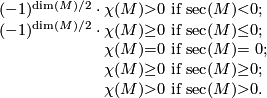
Conjecture 11.2 [Singer Conjecture].
If is an aspherical closed manifold, then  is a closed connected Riemannian manifold with negative sectional curvature, then
11.2 L2-torsion and aspherical closed manifolds
Conjecture 11.3 [-torsion for aspherical closed manifolds].
is an aspherical closed manifold of odd dimension, then is  --acyclic and
  is a closed connected Riemannian manifold of odd dimension with negative sectional curvature, then is --acyclic and
  is an aspherical closed manifold whose fundamental group contains an amenable infinite normal subgroup, then is --acyclic and
11.3 Homological growth and L2-torsion for closed aspherical manifolds
The following conjecture is motivated by [Lück2002, Conjecture 11.3 on page 418] and in particular by the preprint of Bergeron and Venkatesh [Bergeron&Venkatesh2010, Conjecture 1.3].
Conjecture 11.4 [Homological growth and -torsion for aspherical manifolds].
Let be a closed aspherical manifold of dimension . Let

be a nested sequence of in normal subgroups of finite index ![[G:G_i]](/images/math/f/2/a/f2a30fa5acf299fc0fa3a04697e48f8f.png) such that their intersection
such that their intersection
 is the trivial subgroup. Then:
![\displaystyle \begin{array}{rcl} \lim_{i \in I} \;\frac{\ln\big(\bigl|\operatorname{tors}\bigl(H_n(G_i\backslash \widetilde{M};\mathbb{Z})\bigr)\bigr|\bigr)}{[G:G_i]} & = & 0 \quad \text{if}\;\; 2n+1 \not= \dim(M);\\ \lim_{i \in I} \;\frac{\ln\big(\bigl|\operatorname{tors}\bigl(H_n(G_i\backslash \widetilde{M};\mathbb{Z})\bigr)\bigr|\bigr)}{[G:G_i]} & = & (-1)^p \cdot \rho^{(2)}\bigl(\widetilde{M}\bigr) \quad \text{if}\;\; 2n + 1 = \dim(M). \end{array}](/images/math/b/1/3/b131ccd7c3f8b19087cc720b7773d8ef.png)
If is residually finite, then Conjecture 11.4
implies Conjecture 11.3. Conjecture 11.4
has been proved in the special case, where contains an infinite normal elementary amenable subgroup or carries a non-trivial -action,
in [Lück2012]. A very interesting open case is the one of a closed hyperbolic -manifold.
11.4 Q versus Fp-approximation
Conjecture 11.5 [Approximation by Betti numbers].
Let be a closed aspherical manifold of dimension . Let normal subgroups of finite index such that their intersection is the trivial subgroup. Let be any field. Then we get for every 
![\displaystyle b_n^{(2)}(\widetilde{M}) = \lim_{i \to \infty} \frac{b_n(G_i\backslash \widetilde{M};K)}{[G:G_i]}.](/images/math/c/c/f/ccf2f48722da3aee987cd2c352b2fee6.png)
Remark 11.6.
Conjecture 11.5 follows from [Lück1994] in the case that has characteristic zero, actually without the assumption that is aspherical. The interesting and open case is the case of the prime characteristic  , where the assumption "aspherical" is definitely necessary, see for instance [Bergeron&Linnell&Lück&Sauer2012], [Ershof&Lück2012] and [Linnell&Lück&Sauer2011], and one may additionally demand that each index is a -power.
11.5 Simplicial volume and L2-invariants
Conjecture 11.7 [Simplicial volume and -invariants].
be an aspherical closed orientable manifold. Suppose that its simplicial volume  vanishes. Then is of determinant class and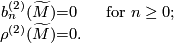
11.6 The Zero-in-the-Spectrum Conjecture
Conjecture 11.8 [Zero-in-the-spectrum Conjecture].
Let be a complete Riemannian manifold. Suppose that is the universal covering of an aspherical closed Riemannian manifold (with the Riemannian metric coming from ). Then for some  zero is in the Spectrum of the minimal closure
  -forms on .
Remark 11.9 [Non-aspherical counterexamples to the Zero-in-the-Spectrum Conjecture].
For all of the conjectures about aspherical spaces stated in this article it is obvious that they cannot be true if one drops the condition aspherical except for the zero-in-the-Spectrum Conjecture 11.8. Farber and Weinberger [Farber&Weinberger2001] gave the first example of a closed Riemannian manifold for which zero is not in the spectrum of the minimal closure  of the Laplacian acting on smooth -forms on for each . The construction by Higson, Roe and Schick [Higson&Roe&Schick2001] yields plenty of such counterexamples. But there are no aspherical counterexamples known.
12 References
- [Arzhantseva&Delzant2008] G. Arzhantseva and T. Delzant, Examples of random groups, preprint (2008).
- [Bartels&Echterhoff&Lück2008] A. Bartels, S. Echterhoff and W. Lück, Inheritance of Isomorphism Conjectures under colimits, K-theory and noncommutative geometry, EMS Ser. Congr. Rep., Eur. Math. Soc., Zürich, (2008) 41–70. MR2513332 Zbl 1159.19005
- [Bartels&Farrell&Lück2011] A. Bartels, F. Farrell and W. Lück, The Farrell-Jones Conjecture for cocompact lattices in virtually connected Lie groups, (2011). Available at the arXiv:1101.0469v1.
- [Bartels&Lück&Reich&Rüping2012] A. Bartels, W. Lück, H. Reich and H. Rüping, K- and L-theory of group rings over GL_n(Z), (2012). Available at the arXiv:1204.2418v1.
- [Bartels&Lück&Reich2008] A. Bartels, W. Lück and H. Reich, On the Farrell-Jones Conjecture and its applications, Journal of Topology 1 (2008), 57–86. MR2365652 (2008m:19001) Zbl 1141.19002
- [Bartels&Lück&Weinberger2010] A. Bartels, W. Lück and S. Weinberger, On hyperbolic groups with spheres as boundary, J. Differential Geom. 86 (2010), no.1, 1–16. MR2772544 (2012b:57003) Zbl 1216.53043
- [Bartels&Lück2012] A. Bartels and W. Lück, The Borel conjecture for hyperbolic and CAT(0)-groups., Ann. of Math. (2) 175 (2012), 631–689. MR2993750 Zbl 06025000
- [Belegradek2006] I. Belegradek, Aspherical manifolds, relative hyperbolicity, simplicial volume and assembly maps, Algebr. Geom. Topol. 6 (2006), 1341–1354 (electronic). MR2253450 (2007f:57004) Zbl 1137.20035
- [Bergeron&Linnell&Lück&Sauer2012] N. Bergeron, P. Linnell, W. Lück and R. Sauer, On the growth of Betti numbers in -adic analytic towers, (2012). Available at the arXiv:1204.3298v1.
- [Bergeron&Venkatesh2010] N. Bergeron and A. Venkatesh, The asymptotic growth of torsion homology for arithmetic groups, (2010). Available at the arXiv:1004.1083v1.
- [Bestvina&Mess1991] M. Bestvina and G. Mess, The boundary of negatively curved groups, J. Amer. Math. Soc. 4 (1991), no.3, 469–481. MR1096169 (93j:20076) Zbl 0767.20014
- [Bryant&Ferry&Mio&Weinberger1996] J. Bryant, S. Ferry, W. Mio and S. Weinberger, Topology of homology manifolds, Ann. of Math. (2) 143 (1996), no.3, 435–467. MR1394965 (97b:57017) Zbl 0867.57016
- [Cannon1991] J. W. Cannon, The theory of negatively curved spaces and groups, Ergodic theory, symbolic dynamics, and hyperbolic spaces (Trieste, 1989), Oxford Univ. Press (1991), 315–369. MR1130181 () Zbl 0764.57002
- [Casson&Jungreis1994] A. Casson and D. Jungreis, Convergence groups and Seifert fibered -manifolds, Invent. Math. 118 (1994), no.3, 441–456. MR1296353 (96f:57011) Zbl 0840.57005
- [Charney&Davis1995] R. M. Charney and M. W. Davis, Strict hyperbolization, Topology 34 (1995), no.2, 329–350. MR1318879 (95m:57034) Zbl 0826.53040
- [Daverman1986] R. J. Daverman, Decompositions of manifolds, Academic Press Inc., 1986. MR872468 (88a:57001) Zbl 1130.57001
- [Davis&Januszkiewicz&Weinberger2001] M. W. Davis, T. Januszkiewicz and S. Weinberger, Relative hyperbolization and aspherical bordisms: an addendum to "Hyperbolization of polyhedra" [J. Differential Geom. 34 (1991), no. 2, 347-388; MR1131435 (92h:57036) by Davis and Januszkiewicz], J. Differential Geom. 58 (2001), no.3, 535–541. MR1906785 (2003e:57038) Zbl 1028.57020
- [Davis&Januszkiewicz1991] M. W. Davis and T. Januszkiewicz, Hyperbolization of polyhedra, J. Differential Geom. 34 (1991), no.2, 347–388. MR1906785 (2003e:57038) Zbl 1028.57020
- [Davis1983] M. W. Davis, Groups generated by reflections and aspherical manifolds not covered by Euclidean space, Ann. of Math. (2) 117 (1983), no.2, 293–324. MR690848 (86d:57025) Zbl 0531.57041
- [Davis2002] M. Davis, Exotic aspherical manifolds, Abdus Salam International Centre for Theoretical Physics, Trieste, 2002. MR1937019 (2004a:57031) Zbl 1070.57012
- [Davis2008] M. W. Davis, The geometry and topology of Coxeter groups, London Mathematical Society Monographs Series, 32. Princeton University Press, Princeton, NJ, 2008. MR2360474 (2008k:20091) Zbl 1142.20020
- [Ershof&Lück2012] M. Ershov and W. Lück, The first -Betti number and approximation in arbitrary characteristic, (2012). Available at the arXiv:1206.0474v1.
- [Farber&Weinberger2001] M. Farber and S. Weinberger, On the zero-in-the-spectrum conjecture, Ann. of Math. (2) 154 (2001), no.1, 139–154. MR1847591 (2003b:58044) Zbl 0992.58012
- [Farrell&Jones1989] F. T. Farrell and L. E. Jones, Negatively curved manifolds with exotic smooth structures, J. Amer. Math. Soc. 2 (1989), no.4, 899–908. MR1002632 (90f:53075) Zbl 0698.53027
- [Farrell&Jones1990] F. T. Farrell and L. E. Jones, Classical aspherical manifolds, Published for the Conference Board of the Mathematical Sciences, Washington, DC, 1990. MR1056079 (91k:57001) Zbl 0729.57001
- [Farrell&Jones1991] F. T. Farrell and L. E. Jones, Rigidity in geometry and topology, Proceedings of the International Congress of Mathematicians, Vol. I, II (Kyoto, 1990), 653–663, Math. Soc. Japan, Tokyo, 1991. MR1159252 (93g:57041) Zbl 0745.57008
- [Farrell&Jones1993] F. T. Farrell and L. E. Jones, Topological rigidity for compact non-positively curved manifolds, Differential geometry: Riemannian geometry (Los Angeles, CA, 1990), Proc. Sympos. Pure Math., 54, Part 3, Amer. Math. Soc., Providence, RI, (1993), 229–274. MR1216623 (94m:57067) Zbl 0796.53043
- [Farrell&Jones1998] F. T. Farrell and L. E. Jones, Rigidity for aspherical manifolds with
 , Asian J. Math. 2 (1998), no.2, 215–262. MR1639544 (99j:57032)Zbl 0912.57012
- [Ferry&Pedersen1995] S. C. Ferry and E. K. Pedersen, Epsilon surgery theory, Novikov conjectures, index theorems and rigidity, Vol. 2 (Oberwolfach, 1993), Cambridge Univ. Press (1995), 167–226. MR1388311 (97g:57044) Zbl 0956.57020
- [Ferry&Ranicki&Rosenberg1995] S. C. Ferry, A. A. Ranicki and J. Rosenberg, Novikov conjectures, index theorems and rigidity. Vol. 1. London Math. Soc. Lecture Note Ser., 226, Cambridge Univ. Press, Cambridge, 1995. MR1388294 (96m:57002) Zbl 0829.00027
- [Ferry&Ranicki&Rosenberg1995a] S. C. Ferry, A. A. Ranicki and J. Rosenberg, Novikov conjectures, index theorems and rigidity. Vol. 2, London Math. Soc. Lecture Note Ser., 227, Cambridge Univ. Press, Cambridge, 1995. MR1388306 (96m:57003) Zbl 0829.00028
- [Ferry&Ranicki&Rosenberg1995b] S. C. Ferry, A. A. Ranicki and J. Rosenburg, A history and survey of the Novikov conjecture in Ferry&Ranicki&Rosenberg1995 7–66, London Math. Soc. Lecture Note Ser., 226, Cambridge Univ. Press, Cambridge, 1995. MR1388295 (97f:57036) Zbl 0954.57018
- [Freden1995] E. M. Freden, Negatively curved groups have the convergence property. I, Ann. Acad. Sci. Fenn. Ser. A I Math. 20 (1995), no.2, 333–348. MR1346817 (96g:20054) Zbl 0847.20031
- [Freedman1982] M. H. Freedman, The topology of four-dimensional manifolds, J. Differential Geom. 17 (1982), no.3, 357–453. MR679066 (84b:57006) Zbl 0528.57011
- [Gabai1991] D. Gabai, Convergence groups are Fuchsian groups, Bull. Amer. Math. Soc. (N.S.) 25 (1991), no.2, 395-402. MR1189862 (93m:20065) Zbl 0785.57004
- [Gallot&Hulin&Lafontaine1987] S. Gallot, D. Hulin and J. Lafontaine, Riemannian geometry, Springer-Verlag, 1987. MR2088027 (2005e:53001) Zbl 1068.53001
- [Gromoll&Wolf1971] D. Gromoll and J. A. Wolf, Some relations between the metric structure and the algebraic structure of the fundamental group in manifolds of nonpositive curvature, Bull. Amer. Math. Soc. 77 (1971), 545–552. MR0281122 (43 #6841) Zbl 0237.53037
- [Gromov1987] M. Gromov, Hyperbolic groups, Essays in group theory,Math. Sci. Res. Inst. Publ., 8, Springer, New York, (1987) 75–263. MR0919829 (89e:20070) Zbl 0634.20015
- [Gromov2003] M. Gromov, Random walk in random groups, Geom. Funct. Anal. 13 (2003), no.1, 73–146. MR1978492 (2004j:20088a) Zbl 1122.20021
- [Helgason2001] S. Helgason, Differential geometry, Lie groups, and symmetric spaces, Corrected reprint of the 1978 original. Graduate Studies in Mathematics, 34. American Mathematical Society, Providence, RI, 2001. MR1834454 (2002b:53081) Zbl 0993.53002
- [Hempel1976] J. Hempel, -Manifolds, Princeton University Press, Princeton, N. J., 1976. MR0415619 (54 #3702) Zbl 1058.57001
- [Higson&Lafforgue&Skandalis2002] N. Higson, V. Lafforgue and G. Skandalis, Counterexamples to the Baum-Connes conjecture, Geom. Funct. Anal. 12 (2002), no.2, 330–354. MR1911663 (2003g:19007) Zbl 1014.46043
- [Higson&Roe&Schick2001] N. Higson, J. Roe and T. Schick, Spaces with vanishing
 -homology and their fundamental groups (after Farber and Weinberger), Geom. Dedicata 87 (2001), no.1-3, 335–343. MR1866855 (2002m:57031) Zbl 991.57002
- [Hirzebruch1958] F. Hirzebruch, Automorphe Formen und der Satz von Riemann-Roch 1958 Symposium internacional de topología algebraica International symposium on algebraic topology, Universidad Nacional Autónoma de México and UNESCO, Mexico City,(1958) 129–144 MR0103280 (21 #2058) Zbl 0129.29801
- [Hirzebruch1971] F. Hirzebruch, The signature theorem: reminiscences and recreation, Prospects in mathematics (Proc. Sympos., Princeton Univ., Princeton, N.J., 1970), Ann. of Math. Studies, No. 70, Princeton Univ. Press, Princeton, N.J. (1971) 3–31. MR0368023 (51 #4265) Zbl 0252.58009
- [Johnson&Wall1972] F. E. A. Johnson and C. T. C. Wall, On groups satisfying Poincaré duality, Ann. of Math. (2) 96 (1972), 592–598. MR0311796 (47 #358) Zbl 0245.57005
- [Kapovich&Benakli2002] I. Kapovich and N. Benakli, Boundaries of hyperbolic groups, in Combinatorial and geometric group theory (New York, 2000/Hoboken, NJ, 2001), Contemp. Math., 296, Amer. Math. Soc., Providence, RI, (2002) 39–93. MR1921706 (2004e:20075) Zbl 1044.20028
- [Kleiner&Lott2008] B. Kleiner and J. Lott, Notes on Perelman's papers, Geom. Topol. 12 (2008), no. 5, 2587–2855. MR2460872 (2010h:53098) Zbl 05530173
- [Kreck&Lück2005] M. Kreck and W. Lück, The Novikov conjecture, Birkhäuser Verlag, Basel, 2005. MR2117411 (2005i:19003) Zbl 1058.19001
- [Kreck&Lück2009] M. Kreck and W. Lück, Topological rigidity for non-aspherical manifolds, Pure Appl. Math. Q. 5 (2009), no.3, Special Issue: In honor of Friedrich Hirzebruch., 873–914. MR2532709 (2010g:57026) Zbl 1196.57018
- [Lawson&Yau1972] J. Lawson and S. T. Yau, Compact manifolds of nonpositive curvature, J. Differential Geometry 7 (1972), 211–228. MR0334083 (48 #12402) Zbl 0266.53035
- [Leeb1995] B. Leeb, -manifolds with(out) metrics of nonpositive curvature, Invent. Math. 122 (1995), no.2, 277–289. MR1358977 (97g:57015) Zbl 0840.53031
- [Linnell&Lück&Sauer2011] P. Linnell, W. Lück and R. Sauer, The limit of
 -Betti numbers of a tower of finite covers with amenable fundamental groups, Proc. Amer. Math. Soc. 139 (2011), no.2, 421–434. MR2736326 (2012a:55016) Zbl 1272.55006
- [Lück&Reich2005] W. Lück and H. Reich, The Baum-Connes and the Farrell-Jones conjectures in - and -theory, Handbook of K-theory. Vol. 1, 2, 703–842, Springer, Berlin, 2005. MR2181833 (2006k:19012) Zbl 1120.19001
- [Lück1994] W. Lück, Approximating -invariants by their finite-dimensional analogues, Geom. Funct. Anal. 4 (1994), no.4, 455–481. MR1280122 (95g:58234) Zbl 0853.57021
- [Lück2002] W. Lück, -invariants: theory and applications to geometry and -theory, Springer-Verlag, Berlin, 2002. MR1926649 (2003m:58033) Zbl 1009.55001
- [Lück2009] W. Lück, -invariants from the algebraic point of view, Geometric and cohomological methods in group theory, Cambridge Univ. Press (2009), 63–161. MR2605176 (2011f:46090) Zbl 1259.57001
- [Lück2010] W. Lück, Survey on aspherical manifolds, European Congress of Mathematics, Eur. Math. Soc., Zürich (2010), 53–82. MR2648321 (2011d:57061) Zbl 1215.57001
- [Lück2012] W. Lück, Approximating L^2-invariants and homology growth, (2012). Available at the arXiv:1203.2827v2.
- [Mess1990] G. Mess, Examples of Poincaré duality groups, Proc. Amer. Math. Soc. 110 (1990), no.4, 1145–1146. MR1019274 (91c:20075) Zbl 0709.57025
- [Morgan&Tian2007] J. Morgan and G. Tian, Ricci flow and the Poincaré conjecture, Clay Mathematics Monographs, 3. American Mathematical Society, Providence, RI; Clay Mathematics Institute, Cambridge, MA, 2007 MR2334563 (2008d:57020) Zbl 1179.57045
- [Morgan&Tian2008] J. Morgan and G. Tian, Completion of the Proof of the Geometrization Conjecture, (2008). Available at the arXiv:0809.4040.
- [Novikov1965] S. P. Novikov, Rational Pontrjagin classes. Homeomorphism and homotopy type of closed manifolds. I, Izv. Akad. Nauk SSSR Ser. Mat. 29 (1965), 1373–1388. MR0196764 (33 #4950) Zbl 0146.19601
- [Novikov1965a] S. P. Novikov, Topological invariance of rational classes of Pontrjagin, Dokl. Akad. Nauk SSSR 163 (1965), 298–300. MR0193644 (33 #1860) Zbl 0146.19502
- [Novikov1966] S. P. Novikov, On manifolds with free abelian fundamental group and their application, Izv. Akad. Nauk SSSR Ser. Mat. 30 (1966), 207–246.
- [Novikov1970] S. P. Novikov, Algebraic construction and properties of Hermitian analogs of -theory over rings with involution from the viewpoint of Hamiltonian formalism. Applications to differential topology and the theory of characteristic classes. I. II, Math. USSR-Izv. 4 (1970), 257–292; ibid. 4 (1970), 479–505; translated from Izv. Akad. Nauk SSSR Ser. Mat. 34 (1970), 253–288; ibid. 34 (1970), 475. MR0292913 (45 #1994) Zbl 0216.45003 Zbl 0233.57009
- [Ol'shanskii&Osin&Sapir2009] A. Y. Ol'shanskii, D. V. Osin and M. V. Sapir, Lacunary hyperbolic groups, Geom. Topol. 13 (2009), no.4, 2051–2140. MR2507115 (2010i:20045) Zbl 1243.20056
- [Quinn1983] F. Quinn, Resolutions of homology manifolds, and the topological characterization of manifolds, Invent. Math. 72 (1983), no.2, 267–284. MR700771 (85b:57023) Zbl 0603.57008
- [Quinn1987] F. Quinn, An obstruction to the resolution of homology manifolds, Michigan Math. J. 34 (1987), no.2, 285–291. MR894878 (88j:57016) Zbl 0652.57011
- [Ranicki1992] A. A. Ranicki, Algebraic -theory and topological manifolds, Cambridge University Press, 1992. MR1211640 (94i:57051) Zbl 0767.57002
- [Rosenberg1983] J. Rosenberg,
 -algebras, positive scalar curvature, and the Novikov conjecture, Inst. Hautes Études Sci. Publ. Math. (1983), no.58, 197–212 (1984). MR720934 (85g:58083) Zbl 0658.53039
- [Scott1983] P. Scott, The geometries of -manifolds, Bull. London Math. Soc. 15 (1983), no.5, 401–487. MR705527 (84m:57009) Zbl 0662.57001
- [Turaev1988] V. G. Turaev, Homeomorphisms of geometric three-dimensional manifolds, (Russian). Mat. Zametki 43 (1988), no.4, 533–542, 575; translation in Math. Notes 43 (1988), no. 3-4, 307–312. MR940851 (89f:57015) Zbl 0646.57008
- [Wall1999] C. T. C. Wall, Surgery on compact manifolds, American Mathematical Society, Providence, RI, 1999. MR1687388 (2000a:57089) Zbl 0935.57003
- [Whitehead1978] G. W. Whitehead, Elements of homotopy theory, Graduate Texts in Mathematics, 61. Springer-Verlag, New York-Berlin, 1978. MR516508 (80b:55001) Zbl 0406.55001
13 External links
The Wikipedia page on aspherical spaces.

